There is a lot of talk about efficiency in the government these days, without much additional detail. The recent launch of the Digital Transformation Office hasn’t offered additional clarity: It just added the pint of water that is the Canadian Digital Service to the ocean that is Shared Services.
Currently the plan to make government more efficient seems to be simply “deploying AI at scale” with little visible consideration for the environment AI is being deployed into.
That environment is largely defined by the governments implementation of the 1960s Matrix organization, along with the 1990s ITIL Service Management help-desk model and 1950s Project Management. This combination has created a toxic environment for technology generally and AI deployment specifically.
Since all government departments have implemented those models the internal worlds are eerily similar across all departments. We can use that similarity to give a sense of the environment and the broad strokes of a problem that I’ll call the efficiency gap.
The ITSM model (which I’ve described previously as the IT paradigm) assumes software is bought rather than built. This means that in the government programmers are extremely rare.
The inability to to create software creates a capability gap (lack of custom/mission-specific software) and an integration gap (an inability to integrate the commercial software you buy to get value out of it; Shopify’s development and use of Slack bots is an example).
The inability to capture/automate government process in software or have automated workflows that span the governments commercial systems creates the efficiency gap; too much manual work, and huge amounts of time spent copying data between spreadsheets and internal systems.
The result is that government processes scale by adding people (examples: the immigration backlog, passports) instead of consuming more CPU cycles.
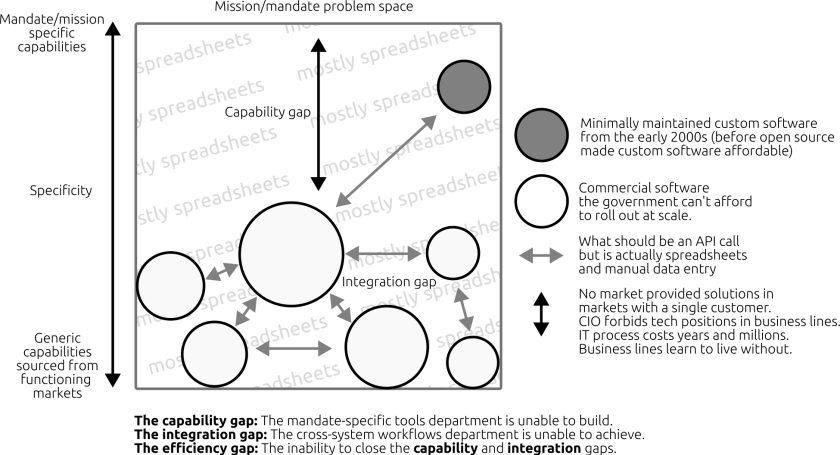
On it’s face it looks like filling in the capability and integration gaps with some generated applications and APIs, will close the efficiency gap. AI is great at that! Let’s get started!
Love the enthusiasm, but this has been done before.
Digital Transformation: A cautionary tale
The Canadian Digital Service faced exactly those gaps when it launched in 2017. Founded to fix a digital landscape with few digital services of generally poor quality, we jumped into action building the missing apps.
Looking back, we fell for survivorship bias: Once a few of our apps joined the silent graveyard, the actual problem came into view. What needed fixing was the policy and process that was making digital service delivery nearly impossible. A startup would have pivoted, but CDS was never really able… the problems they discovered were firmly in the mandate of other departments.
The effort to “deploy AI at scale” is going to hit the same problems.
The top-down problem
While consequences like “inefficiency” are visible from the 30,000 foot view of the executive, the causes are not.
The implication is executives looking down at an efficiency problem and ordering folks to “deploy AI at scale”, might be “directionally correct” but falls into the same survivorship bias problem of attacking the consequence and not the cause.
Top-down change efforts are extremely susceptible to being fooled by survivorship bias.
AI isn’t the first technology that could make things “efficient”. Why haven’t any of the previous technologies (SOA, cloud, APIs, containers, microservices, zero-trust, low-code, etc) the government tried to deploy “at scale” succeeded, let alone solved this problem? (Don’t forget that we’ve been unable to address our legacy tech for 24 years now)
An honest exploration of that question is going to lead to places that aren’t even technology, let alone AI: HR, culture (itself an effect and not a cause), policy, process, procurement.
Digital AI transformation
While I love the “damn the torpedoes, full speed ahead” energy that AI psychosis seems to give, I don’t see why the government should expect to have more success with something as complex, expensive and notoriously insecure as AI, when it struggled to deploy far simpler technologies.
Personally I think there are far simpler and more impactful (in terms of efficiency) interventions to be made, like proper organizational design (1, 2), requiring departments to create technical career paths (a uni-lingual technical path from IT-01 to IT-05; read more here) and taking a scalpel (not a chainsaw) to the policy suite and governance structures (read more here).
If some of that more meaningful work gets done as part of an AI transformation push, I’m ok with some wasted tokens along the way.